Sometimes I just want to know what it is like to be normal. To be human. Allow the normal flow of emotions to come and go. Experience life the way "normal" people do. I am not normal. At least not what most people would call normal.
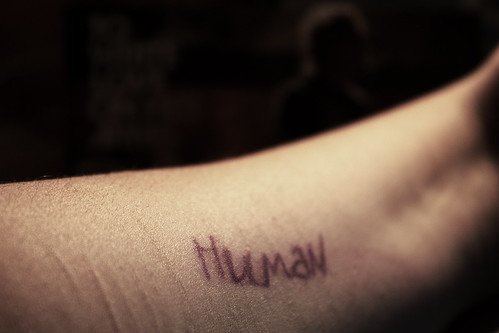
Self injury, or self mutilation, is not an illness or disease that is limited by the color of your skin, sexual orientation, your faith, your bank account, or your education. Most of the time this behavior is not done in a "cult" or group like setting, rather alone. While those who engage in such a behavior typically try to hide it, many are finally coming out and admitting it. Telling their stories helps in their healing process.
The first image that comes to my mind is those whom cut themselves. Self injury can involve so much more. Burning, or branding with hot objects. Hitting. Breaking their own bones. Hair pulling, which can lead to hair eating. Picking at the skin or reopening old wounds. Scratching. Biting.
Who are these people who engage in these acts? They are your mother, brother, sister, aunt, father, daughter, son, cousin, best friend, your spouse. Self mutilation most commonly occurs in adolescent females. People who have a history of abuse. Self mutilation is often a symptom of other mental illnesses such as Bipolar Disorder, Personality Disorders (particularly Borderline Personality Disorder), Schizophrenia, and Anxiety Disorders.
Self mutilation is not a new concept for us. The following is a portion of a timeline that can be found at http://wso.williams.edu/~atimofey/self_mutilation/History/index.html . It demonstrates the importance and impact of this behavior through out time.
Timeline: Self-Mutilation in History
- 496-406 BCE Sophocles, Ancient Greece In Sophocles's play, Oedipus unwittingly kills his father and marries his mother, Jocasta. After Jocasta kills herself, Oedipus blinds himself by sticking her golden brooches through his eyes while crying,"Wicked, wicked eyes! You shall not see me nor my shame- Not see my present crime. Go dark, for all time blind to what you should have never seen"
- 2nd-4th Century CE Mark 9:47-48: "If your eye is your downfall, tear it out! Better for you to enter the kingdom of God with one eye than to be thrown with both eyes into Gehenna, where the worm dies not and the fire is never extinguished."Matthew 6:22-23: "What I say to you is: anyone who looks lustfully at a woman has already committed adultery with her in his thoughts. If your right eye is your trouble, gouge it out and throw it away! Better to lose part of your body than to have it all cast into Gehenna."
- 11th Century Self-mutilation as an expression of the Christian faith was practiced by "flagellant Christian cults from the eleventh century on (Favazza 1987), numerous nuns and saints of the Middle Ages who were known to starve purge, flagellate, and scar themselves (Bell 1985), and even in the self-flagellation of today's Roman Catholic Opus Dei movement."
- 1846 The first case report on self-mutilation was published. It describes a guilt-ridden widow who enucleated both of her eyes.
- 1888 Artist Vincent van Gogh, angry with a housemate, cut off his earlobe and sent it to a prostitute named Rachel. It has been asserted that she held significance because of her name, evoking the biblical figure who "grieved for her children". Van Gogh "may have wanted her to grieve for and to love him."
- 1920 Freud's proposed life and death instincts: "In Freud's theory of the death instinct, the person withdraws from human connections and retreats into a narcissistic position, silently driving him or herself toward death. Freud emphasized that it was only through the activity of the life instinct that this death-like force was projected outward as destructive impulses to objects in the outside world."
- 1938 Karl Menninger suggested that self -mutilation might be an effort to heal oneself. He wrote, "Local self-destruction is a form of partial suicide to avert total suicide." Menninger also classified the behavior into four categories: neurotic, psychotic, organic, and religious.
- 1983 Modern psychiatric interest in self-mutilation was marked by a 1983 paper by Pattison and Kahan. Using 56 published reports, Pattison and Kahan classified self-mutilation on the basis of lethality, method, and repetition, constructing a chart in which all self-damaging behaviors could be classified.
- 1990 The most widely accepted classification of self-mutilation was constructed by Favazza and Rosenthal, presented in the book, Bodies Under Siege (1996)
There is hope. If you are a mutilator please know two things. One, you are not alone. Two, you can control it. Take the steps necessary to overcome the need, the desire, and the ritual of harming oneself.
- Decide to stop. Think about why you want to stop and set up a timeline of when to stop. This will help you mentally prepare for the challange ahead.
- Confide in someone.
- Identify triggers. What causes you to cut?
- Recognize that self injury is an attempt to self soothe.
- Figure ot what function the self injury is serving. Is it to release anger? Express guilt?
- Deal with the anger: Try running, dancing, screaming, boxing, or other physical activity to release the anguish and pressure.
- Cope with your emotional numbness: Squeeze ice cubes, take cold showers.
- Calm yourself: Journal, yoga, take a bubble bath.
- See blood: Draw with a red marker on your skin where you normally would cut yourself.

There is something to feeling your skin break that releases a stress, a heavy burden. There is freedom and confinement in self mutilation. The freedom being it is your choice. The confinement of course is the loneliness and self alienation that I feel when I have to hide it.
Personally I have moved my own self inflicted pain from scratching and cutting to a different outlet. Piercing and tattoos. The way my body becomes alive as the needle pierces through my skin is amazing. Hot and burning my flesh is alive. I feel something I can describe, something I control. Heart beat escalates, senses heightened, and afterwords I have a socially acceptable form of self injury that looks beautiful compared to scars.
The constant writing and blogging helps release emotional burden that would have in the past been buried deep inside and allowed to build. Therapy has given me the tools to recognize my emotions. To build on my self worth and self esteem. Workbooks allow me to think about why I really do not like parts of me. Buddhism has challenged my mind to see the world in a different light, to see me differently.
I am recognizing when I feel the need, which is a great step. There is still a long road ahead for me. My goal by sharing some of the facts, resources and a little of my own personal history is that I can show even one person hope. Please visit the sites below and seek professional help if you feel you may be a self mutilator.
Resources used:
http://wso.williams.edu/~atimofey/self_mutilation/
http://www.helpguide.org/mental/self_injury.htm
http://en.wikipedia.org/wiki/Self-harm
http://www.webmd.com/anxiety-panic/guide/self-injury
http://www.selfinjury.com/


No comments:
Post a Comment